

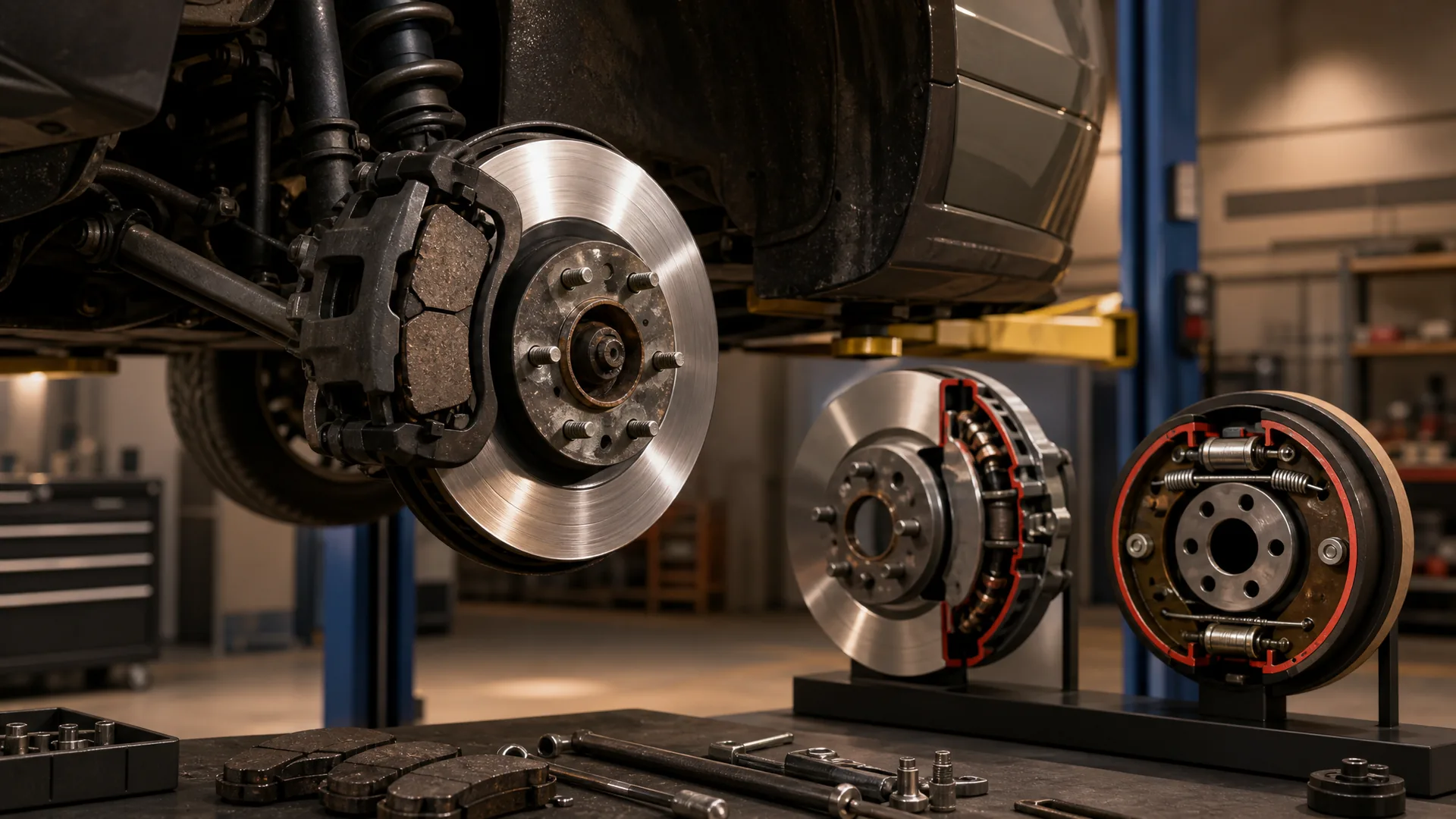
How Much Does a Brake Job Cost? 2026 Guide
Brake repairs sit in that awkward zone of car maintenance where you know you need it, but you have no idea what it should cost until a shop hands you an invoice. Search around and you'll find plenty of national average figures. The trouble is, those averages rarely match what you'll actually pay in your city, on your car, at your mechanic.
How Much Does a Brake Job Cost on Average?
A pads-only brake job typically lands on the lower end of the price range. It's mostly labor plus a set of pads. Once rotors enter the picture, the price climbs. Now you're adding parts and extra labor time to machine or swap them out.
That range is a starting point, not a quote. National averages blend big-city labor rates with small-town shops, luxury cars with economy hatchbacks, worn-but-usable rotors with rotors that need full replacement. No single number captures all that variation.
Front Brake Job Price vs. Rear Brake Repair Cost
Front brakes usually cost more to fix than rear brakes. Most cars lean harder on the front brakes for stopping power, so the pads and rotors up front wear faster and carry more load.
Rear brake systems are sometimes simpler, but not always. Some vehicles use rear drum brakes, which involve different parts and labor steps than a rear disc setup. Others build electronic parking brakes into the rear calipers. That can add diagnostic and calibration time your mechanic needs to bill for.
Brake Pad Replacement Cost Explained
Every brake pad replacement cost breaks down into two pieces: parts and labor. Parts cost depends on the pad material and brand. Labor cost depends on how long the job takes and what the shop charges per hour.
Labor tends to be the bigger swing factor. A straightforward pad swap on an accessible caliper takes less time than a job where the mechanic has to deal with rusted hardware, worn slide pins, or a stuck caliper bracket. That extra time shows up directly on your bill.
Ceramic, Semi-Metallic, and Organic Pad Price Differences
Ceramic pads generally cost more than semi-metallic or organic pads. They also tend to run quieter and produce less brake dust. That's why many shops recommend them for daily drivers.
Semi-metallic pads usually sit in the middle of the price range. They handle heat well, which makes them a common choice for drivers who tow or do a lot of stop-and-go city driving.
Organic pads are often the least expensive option upfront. They wear faster than ceramic or semi-metallic pads, though, which can mean more frequent replacement down the road.
None of these differences are huge on their own. Stack them together with labor rates and rotor decisions, and the total swing between a budget brake job and a premium one gets substantial.
Rotor and Brake Cost Estimate: When You Need More Than Pads
Rotors don't need replacing every time you replace pads, but the two often go together. A worn or warped rotor won't grip the new pads properly. Replacing pads without addressing bad rotors is a common way to end up back in the shop within a few months.
A full rotor and brake cost estimate needs to include either resurfacing or replacement, depending on how far along the rotor wear is. Resurfacing shaves a thin layer off the rotor surface to smooth out imperfections. It costs less than replacement, but it only works if the rotor still has enough material left to spare.
Signs You Need New Rotors, Not Just Resurfacing
A few signs point toward full replacement rather than resurfacing:
Grinding or deep scoring on the rotor surface
Pulsing or vibration through the brake pedal when stopping
Rotor thickness measuring below the manufacturer's minimum spec
Visible cracks, especially near the edge of the rotor
Mechanics generally recommend replacing rotors alongside pads once rotor thickness drops below the manufacturer's minimum spec, rather than resurfacing them repeatedly. Resurfacing a rotor that's already thin just pushes it closer to failure. Skipping that replacement now often means paying for the same repair twice.
How Much Brakes Cost by Car Model
Ask how much brakes cost by car model and the honest answer is: it depends heavily on what you drive. A compact sedan needing a straightforward front pad swap sits at the low end of the cost range. A luxury SUV needing pads, rotors, and sensor replacement on all four corners lands much closer to the high end.
Economy cars generally use simpler brake systems with widely available, lower-cost parts. Most independent shops stock these parts or can get them quickly, which keeps labor time, and your bill, down.
Economy Cars vs. Luxury and Performance Vehicles
European luxury and performance vehicles tend to cost more to fix, and it's not just badge markup. These cars often use larger rotors, more complex caliper designs, and brake pad sensors that need replacing along with the pads themselves. Parts can also be pricier because they're sourced through fewer suppliers.
Labor adds to the gap too. Some luxury models require special tools or extra steps, like resetting an electronic parking brake before the calipers can move. That takes a shop longer to complete the job.
Performance vehicles often add another layer: bigger brake components built for higher heat tolerance, which cost more to manufacture and to replace when they wear out.
Why Brake Job Prices Vary by City and Shop
This is where national averages fall apart. Labor rates differ by metro area, sometimes by a wide margin. Shop rent, technician wages, and local demand all factor into what a shop charges per hour.
Where you take your car matters as much as where you live. Dealership service centers often charge higher labor rates than independent shops, partly because of overhead and partly because they specialize in one or a few brands. Independent shops often price brake jobs lower than dealership service centers for the same parts quality, simply because of overhead differences. Chain repair shops fall somewhere in between, with pricing that can vary a lot from one location to the next even within the same brand.
Getting a Local, Accurate Estimate Instead of a National Guess
None of this means you have to guess. AutoGnome's Repair Estimator pulls city-specific pricing so a driver in a high-cost metro isn't quoted the same number as someone in a lower-cost region. Instead of comparing your quote to a national average that may not apply to you, you can get a city-specific repair estimate built around your car, your repair, and your ZIP code.
If a warning light is what sent you searching for brake costs in the first place, it helps to know what you're dealing with before you book anything. You can decode a dashboard warning light to confirm whether it's actually brake-related or something else entirely.
How to Avoid Overpaying for a Brake Job
Before you approve any brake work, it's worth checking whether you actually have to pay for it. Some brake components are covered under manufacturer recalls, so it makes sense to check for an open brake-related recall before a shop bills you for parts that might be free to replace.
Once you know you're paying out of pocket, a little homework goes a long way. Get a written estimate before any work starts, and ask the shop to break down parts versus labor. That breakdown makes it easier to compare quotes across shops, since labor rates are usually where the biggest differences hide.
Questions to Ask Your Mechanic Before Approving Work
Ask your mechanic these questions before you say yes to a brake job:
Are you replacing rotors, resurfacing them, or leaving them as-is, and why?
What pad material are you using, and is there a cheaper or higher-grade option?
Does the price include hardware like clips, sensors, and shims, or are those extra?
Is there a warranty on the parts and labor?
What's the labor rate per hour, and how many hours is this job estimated at?
A shop that answers these clearly, without hedging, is usually one you can trust with the work. After the job's done, it's worth setting a reminder to track your brake service history so you know exactly when the next inspection or pad change is due, instead of waiting for a grinding noise to remind you.
Skip the national averages and get a number that actually matches your car and your city. AutoGnome's Repair Estimator gives you that local, realistic price range, plus a way to connect with a trusted shop nearby instead of rolling the dice on the first quote you get.