
OBD Auto Repair: What That Code Actually Means
Your check engine light flicks on. Maybe you grabbed a cheap scanner, plugged it in, and got a cryptic code like P0420. Now what? That little port under your dash — the OBD-II connector — is one of the most useful tools in modern car ownership, but only if you know what it's telling you and who to trust with the fix.
Here's a straight-talk guide to OBD auto repair: how the system works, what the codes mean, and how to find a shop that treats the cause instead of just resetting the light.
What OBD Actually Is
OBD stands for On-Board Diagnostics. Every car sold in the U.S. since 1996 runs OBD-II, a standardized system that monitors your engine, transmission, emissions, and dozens of other subsystems. When a sensor reads something out of spec, the computer stores a Diagnostic Trouble Code (DTC) and usually lights up the check engine light.
That standardization is the good news: a scanner from any brand plugs into the same 16-pin port and speaks the same language. The catch? A code tells you where the problem showed up — not always what's causing it.
How to Read a Trouble Code
Codes follow a pattern. Take P0420 as an example:
P — Powertrain (B is Body, C is Chassis, U is Network)
0 — Standardized, generic code shared across manufacturers
4 — The subsystem (here, emissions/catalyst)
20 — The specific fault
P0420 translates roughly to "catalyst system efficiency below threshold." Sounds like a bad catalytic converter, right? Maybe. But it can also be a lazy oxygen sensor, an exhaust leak, or a misfire upstream dumping unburned fuel into the cat. This is exactly where OBD auto repair goes sideways — swapping a $1,200 converter when a $40 sensor was the real culprit.
Step-by-Step: From Code to Fix
Pull the code yourself first. A basic OBD-II reader costs under $30, and most auto parts stores will scan it free. Write down every code, not just the first one. Multiple codes often point to a single root cause.
Note the symptoms. Rough idle? Lost power? Bad fuel economy? A noise when you turn? Symptoms give a good tech the context a code can't. Jot down when it happens — cold starts, hard acceleration, highway speeds.
Check for the obvious. A loose or cracked gas cap throws evaporative-system codes constantly. Tighten it, drive a few cycles, and see if the light clears before you spend a dime.
Don't just clear it and hope. Erasing a code without fixing the problem means it comes back — and you've wiped the freeze-frame data a tech could've used to diagnose it faster.
Match the code to the right specialist. Transmission codes (P07xx) need a transmission shop. Electrical and network codes (U-series) need someone who's good with wiring. More on that below.
Get a proper diagnosis. A quality shop confirms the cause before replacing parts — testing sensors, checking live data, inspecting wiring. The code is the starting point, not the diagnosis.
What Separates a Good OBD Diagnosis From a Bad One
Code reading is cheap. Real diagnostics is a skill. Here's what to look for when you hand your car over:
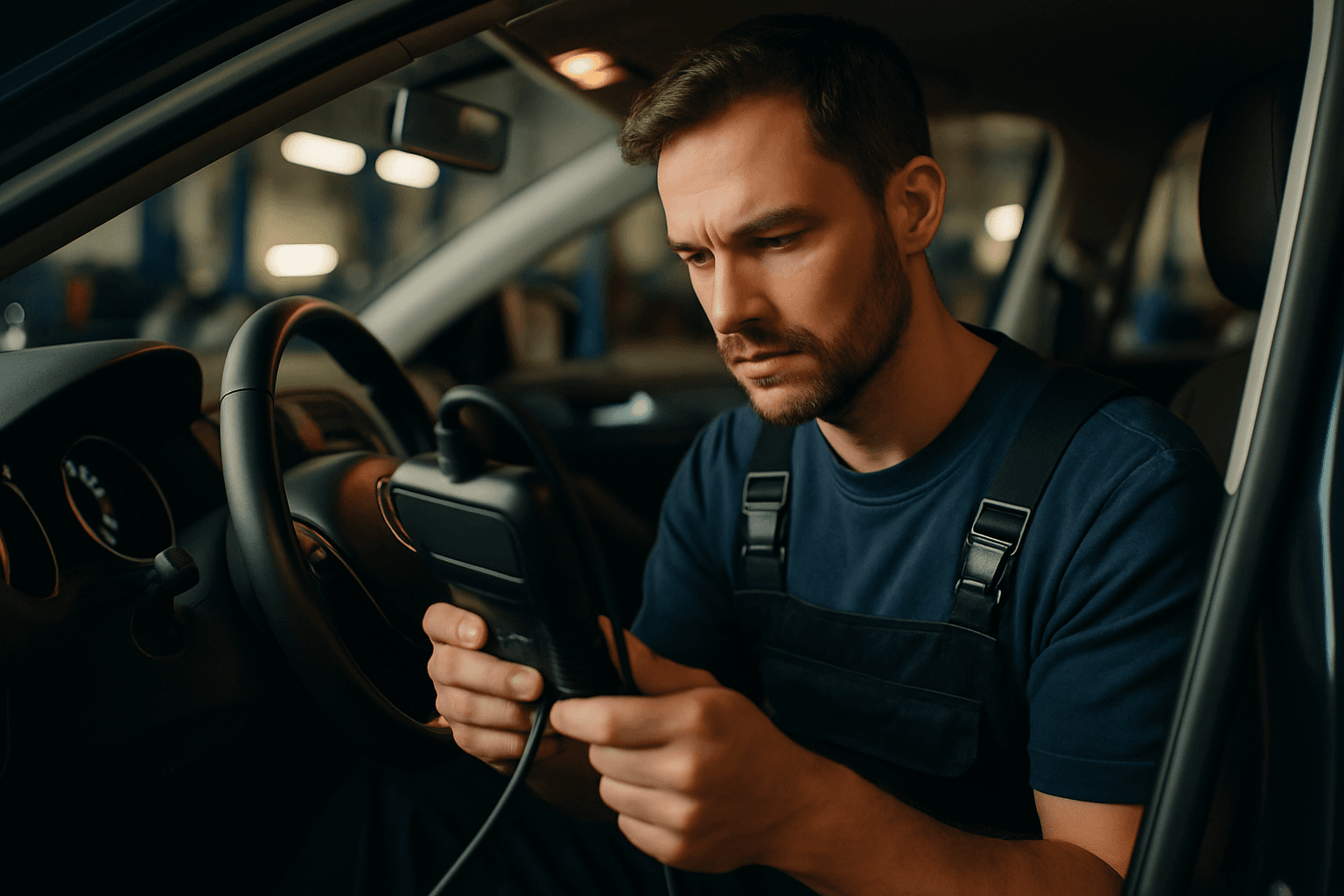
They use a professional scan tool, not a $30 reader. Pro-grade scanners pull live data streams, manufacturer-specific codes, and bidirectional controls that let a tech command components to test them. That depth is the difference between guessing and knowing.
They explain the difference between the code and the cause. If a shop quotes you a part the second you mention a code — before testing anything — walk. A good tech says, "The code points here, let me confirm it before we replace anything."
They check freeze-frame data. When a code sets, the computer snapshots conditions — RPM, temp, load. A thorough tech reads that to recreate the fault.
They give you the actual code numbers. You should leave knowing exactly what was stored and what was fixed. Vague answers like "it was the computer" are a red flag.
They stand behind the repair. If the light comes back for the same issue, a quality shop re-diagnoses on their dime.
Red Flags to Watch For
Be cautious if a shop:
Quotes a major part (catalytic converter, transmission, ECM) off a single code with no testing
Can't or won't tell you which code they read
Clears the light and sends you off without a written diagnosis
Charges for "diagnostics" but only plugged in a basic reader
Common OBD Codes and Who to Call
Different fault areas call for different expertise. A few examples:
P07xx / P08xx (transmission): Shift solenoids, speed sensors, and clutch issues live here. You want a drivetrain specialist. Find Transmission Repair shops that handle this properly.
C-series and axle vibration codes: Driveline faults and worn CV joints show up as noise and vibration. Find CV Axle Repair shops for these.
P0420 / P0430 and O2 sensor codes: Often tied to the exhaust system and catalyst. A good exhaust shop can test for leaks before condemning the cat. Find Exhaust & Muffler Repair shops near you.
U-series (network/communication) codes: These are electrical gremlins — bad grounds, chafed wiring, failing modules. They need a methodical electrical diagnostician. Find Auto Electrical Repair shops who actually enjoy chasing wiring.
Should You DIY or Go to a Shop?
Pulling the code yourself is always worth it — it saves time and gives you leverage in the conversation. Simple fixes like a gas cap, air filter, or an easy-to-reach sensor are fair game if you're handy.
But when the code points to drivability, emissions, transmission, or electrical faults, a professional diagnosis pays for itself. Replacing the wrong part is more expensive than an hour of diagnostic labor, and a good tech gets it right the first time.
The bottom line: the code is a clue, not a verdict. Find a shop that treats it that way, and you'll spend money on the actual problem — not a parts-cannon guess.
Ready to get that light sorted? Find local auto shops on AutoGnome and filter by the exact service your car needs — no ads, no chains, just independent shops that know how to diagnose.