
OBD Auto Repair: What That Code Really Means
Your check engine light flicks on, and suddenly your dashboard looks like a slot machine. Before you panic or shell out for a tow, here's the good news: your car is trying to tell you exactly what's wrong. That's what OBD — On-Board Diagnostics — is for. Every car built since 1996 has an OBD-II port, and it's the gateway to figuring out what's actually going on under the hood.
Let's walk through how OBD diagnostics work, what those codes mean, and how to find a shop that reads them right instead of guessing.
What OBD Actually Does
OBD is your car's built-in self-monitoring system. Dozens of sensors watch everything from your oxygen levels to your transmission behavior. When something drifts out of spec, the system logs a Diagnostic Trouble Code (DTC) and often triggers that check engine light.
Those codes follow a standard format — a letter followed by four numbers, like P0300. The letter tells you the system:
P — Powertrain (engine, transmission)
B — Body (airbags, lighting, climate)
C — Chassis (ABS, steering, suspension)
U — Network (communication between modules)
So P0300 means a random engine misfire. P0171 means your engine is running lean. The code narrows down the area — but it does not diagnose the root cause. That part takes a real technician.
How to Read Your OBD Codes (Step by Step)
You can pull your own codes before you ever visit a shop. It's a smart move — it tells you whether you're dealing with something urgent or something that can wait until the weekend.
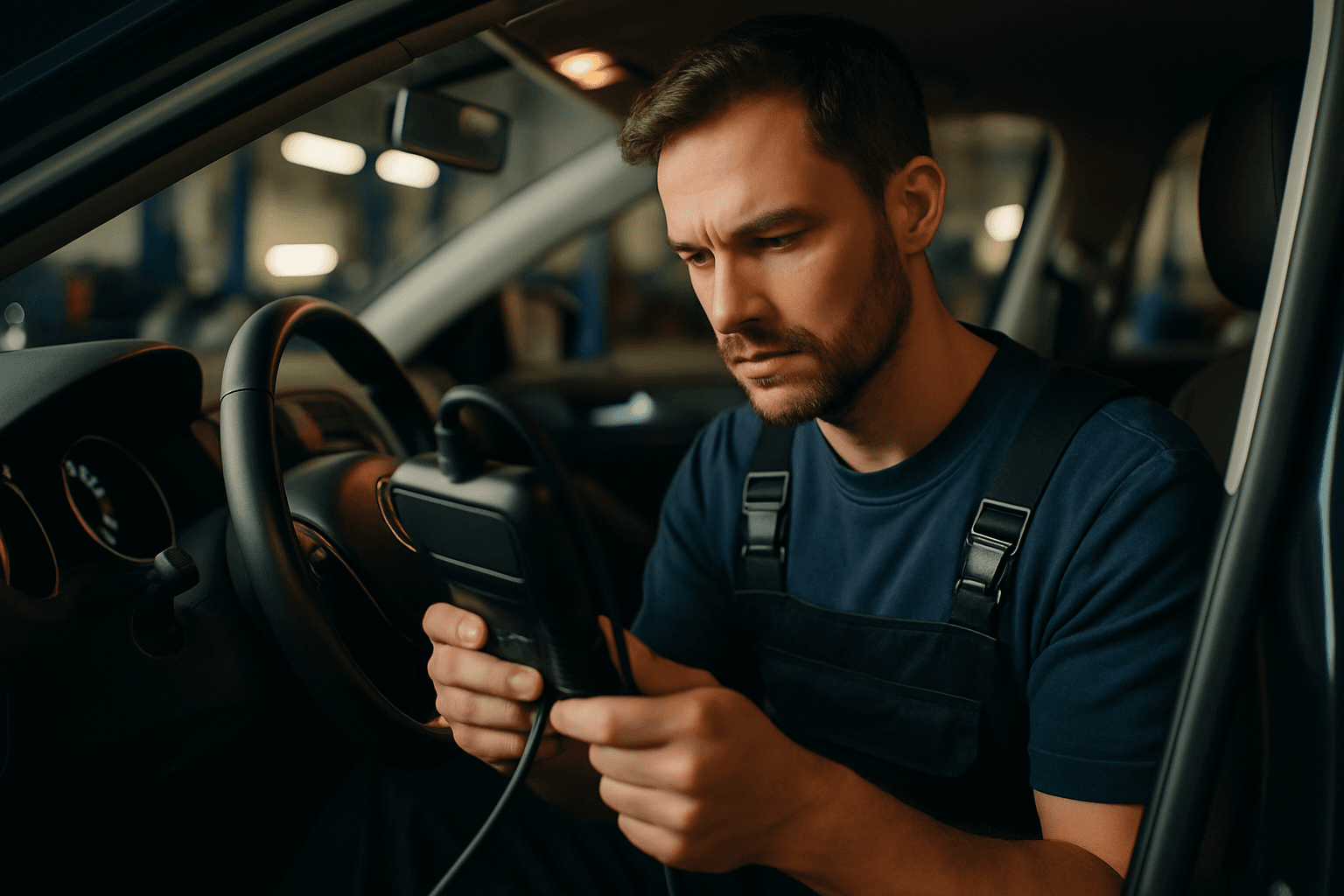
Get a code reader. Basic OBD-II scanners cost $20–$40. Bluetooth dongles that pair with a phone app run a little more and are worth it if you like having data on hand.
Find the port. It's almost always under the dash on the driver's side, within reach of the steering column. Look for a 16-pin trapezoid-shaped connector.
Plug in with the key on, engine off. Turn the ignition to the "on" position without starting the car. The scanner powers up through the port.
Read the codes. The scanner pulls stored codes and sometimes "pending" codes that haven't triggered the light yet. Write them all down.
Look them up. Search the exact code plus your make and model. Generic codes mean the same thing across brands; manufacturer-specific codes (starting P1, for example) need brand context.
Don't clear the codes yet. Clearing them erases the evidence a shop needs. Let a tech see them before you reset anything.
Why a Code Isn't a Diagnosis
Here's where plenty of car owners — and some parts-counter employees — get it wrong. A code points to a symptom, not the failed part. A P0420 "catalyst efficiency below threshold" code doesn't automatically mean you need a $1,200 catalytic converter. It could be a bad oxygen sensor, an exhaust leak, or a fouled cat caused by an unrelated misfire upstream.
Throwing parts at a code is how people end up spending money fixing the wrong thing. A good shop uses the code as a starting point, then confirms the actual cause with live data, pinpoint testing, and experience.
What a Quality OBD Diagnosis Looks Like
When you hand your car to a shop with the light on, the diagnostic process should be more than plugging in a scanner and reading the first line. Watch for these signs of a shop that does it right:
They review freeze-frame data. When a code sets, the car snapshots conditions — engine temp, RPM, load, speed. A sharp tech uses that to recreate the fault.
They look at live sensor data. Watching your sensors in real time shows whether a reading is actually wrong or whether a sensor itself failed.
They test before they replace. Pinpoint tests on wiring, connectors, and components separate a bad part from a bad circuit.
They explain it in plain English. You should leave understanding what's wrong and why — not just handed a code and an estimate.
They charge a fair diagnostic fee. Expect to pay for diagnostic time (often $75–$150). A shop that waives it only if you authorize repairs is fine; one that "guesses for free" usually isn't.
Red Flags to Watch For
Not every shop handles OBD work the same way. Steer clear if you notice:
They quote a repair based only on the code, with no further testing.
They clear the code and send you off without explaining the cause.
They can't show you the data or walk you through their reasoning.
They push the most expensive possible fix before confirming it's necessary.
Common Codes and Where They Lead
Some trouble codes point toward specialized repairs. Knowing the category helps you find the right shop faster:
Transmission codes (P07xx): shifting problems, slipping, or torque converter faults often call for a transmission specialist. You can Find Transmission Repair shops that handle diagnostics beyond the basics.
Electrical and network codes (U-codes, Bxxxx): communication faults and sensor circuit issues need someone comfortable chasing wiring. Look for a shop that lists auto electrical troubleshooting as a service.
Emissions codes (P0420, P0430): catalyst and oxygen sensor codes sometimes trace back to the exhaust. A shop that does exhaust and muffler service can check for leaks before anyone condemns the cat.
When to Fix It Now vs. Later
A steady check engine light usually means you can keep driving carefully and schedule service soon. A flashing check engine light is different — it signals an active misfire that can damage your catalytic converter fast. Pull over, shut it down, and get it looked at before you drive far.
Codes tied to oil pressure, temperature, or braking systems deserve immediate attention too. When in doubt, get it diagnosed rather than hoping the light goes off on its own.
Finding the Right Shop for OBD Work
The best OBD repair comes from shops that treat diagnostics as a craft, not a parts-sales pitch. You want a tech who reads the data, tests their theory, and fixes the real problem the first time. Filtering by the specific service your code points to saves you from bouncing between shops that don't handle your issue.
Ready to get that light sorted? Find local auto shops on AutoGnome — search by your exact make and model, read real reviews, and connect directly with independent shops that know how to diagnose instead of guess.